by Christine Sarkes
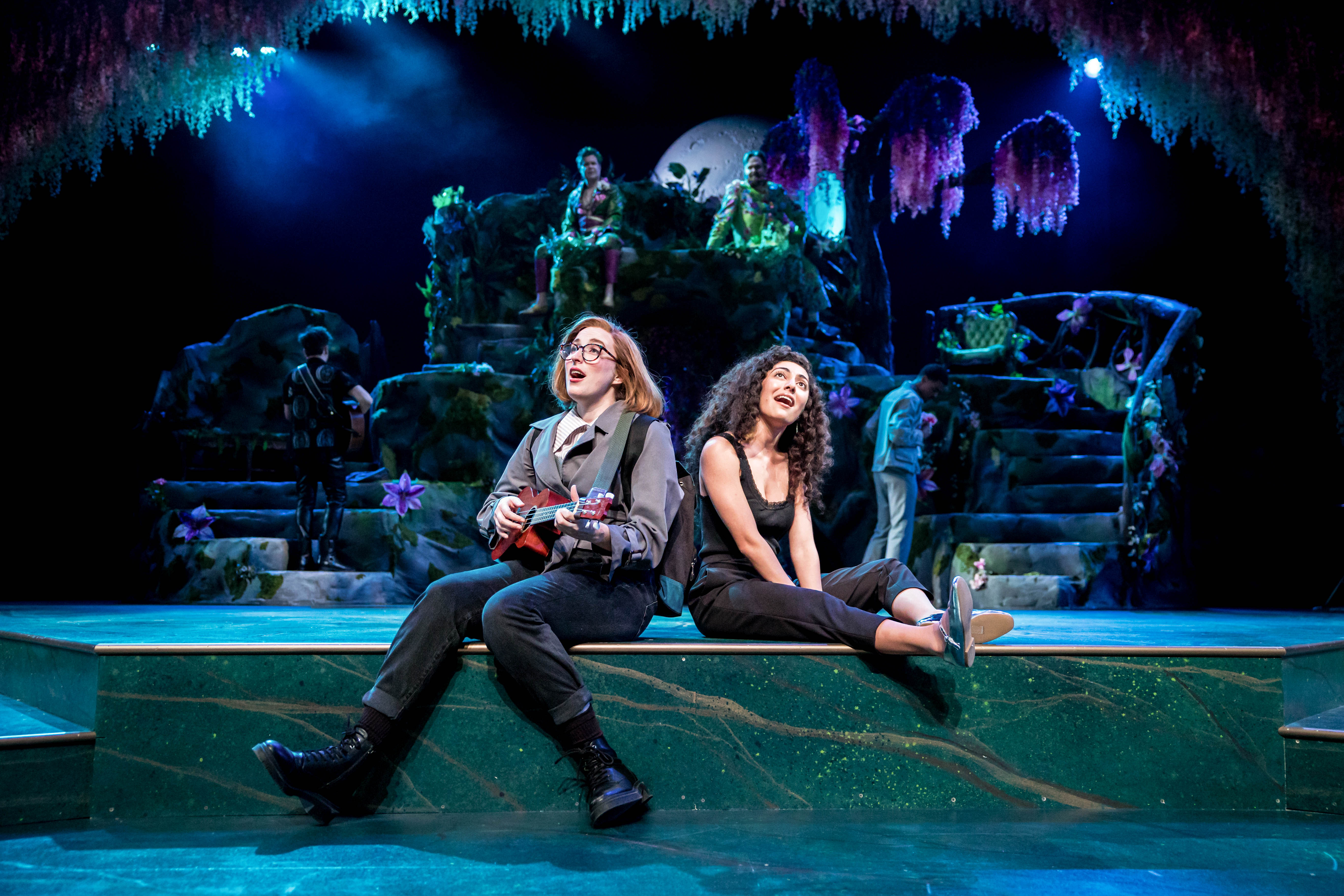
A Midsummer Night’s Dream is magic come to life on the Wurtele Thrust Stage at the Guthrie Theater, now through March 23. Director Joseph Haj and his creative team infuse so much heart and humor into this production, it may be the perfect date night experience and set a new creative benchmark for William Shakespeare’s beloved comedy. Haj extracts every ounce of vitality and joy out of the fantasy that features both the idyllic and darker sides of romantic love. The pitch-perfect acting and physical comedy of Guthrie newcomers and veterans draw the audience intimately into the unfolding plot and bring to life Shakespeare’s gorgeous verse. In it you will find: “The course of true love never did run smooth” “Lord, what fools these mortals be,” “Love looks not with the eyes, but with the mind; And therefore is wing’d Cupid painted blind,” and “Though she be but little, she is fierce!” The play’s themes of waxing and waning phases of love, hate, desire, hubris, and filial responsibility are timeless and the contemporary-ish choice of music and costuming highlight that element. I loved this production so much that I practically ordered my theater-trained daughters to attend and humbly do the same to you, gentle readers.
The plots and subplots are a bit convoluted, but the clever staging helps to sort out the storylines. The play begins when nobleman Egeus asks Duke Theseus to uphold an old law allowing him to choose his daughter’s husband. He chooses Demetrius to marry Hermia, who refuses and proclaims her love for Lysander. Lysander and Hermia plot to run away together through the woods so Hermia isn’t forced to marry Demetrius. Hermia reveals the plan to her best friend Helena, who in turn tells Demetrius to win his love and favor. An acting troupe called the Mechanicals (Nick Bottom, Tom Snout, Peter Quince, Francis Flute, Snug, and Robin Starveling) meet in the woods to rehearse a play to celebrate the wedding of Duke Theseus to Hippolyta. In the woods, the fairy King Oberon and Queen Titania argue about a changeling boy that Oberon wants for himself but Titania refuses to give up. Oberon decides to get his revenge on Titania by sending his servant Puck to find a flower which has the power to make someone fall in love with the first living thing they see upon awakening. Demetrius chases Hermia into the woods and is followed by Helena. Oberon sees Demetrius and Helena arguing and decides to help her by using the potion on Demetrius. Unfortunately, Puck mistakenly gives it to Lysander who then falls in love with Helena. Puck uses magic to turn Bottom’s head into a donkey head to punish him for his vanity while he is rehearsing in the forest. Titania sees Bottom and falls in love with him. Puck tries to fix his mistake with Lysander and puts some potion in Demetrius’ eyes as well. Demetrius then also falls in love with Helena which causes more confusion between the four lovers. Oberon and Puck use more magic and love potion to reconcile the lovers and remove the donkey’s head from Bottom. Oberon then reunites with Titania. In the final act, Theseus finds the lovers in the forest and blesses their marriages. The Mechanicals then perform their play for Theseus at his wedding to Hippolyta and all ends happily.
The young lovers — Ari Derambakhsh (Hermia), Jonathan Luke Stevens (Lysander) Justin Withers (Demetrius) and Royer Bockus (Helena) — are the heart of the play and they are each truly excellent in their roles. Bockus as Helena steals the show with her comically poignant portrayal of the “plain” best friend who never gets the guy. Stevens as the lovelorn Lysander was also very funny as a Billie Joe Armstrong/Green Day wannabe.
Remy Auberjonois is a comic revelation as the scene-chewing Nick Bottom. Dustin Bronson as Snug/Fairy, Aimee K. Bryant as Tom Snout/Fairy, Kimberly Richardson as Robin Starveling/Fairy, William Sturdivant as Egeus/Peter Quince, are adorably funny as the remaining Mechanicals and provide many memorable moments as comic relief. My companion was not enamored of the Mechanicals being portrayed solely in their role as lower-class buffoons, preferring an interpretation of the players as the practical, earthy commonplace folk who illuminate the play’s themes and deeper, primal meanings.
John Catron as Theseus/Oberon and Regina Marie Williams as Hippolyta/Titania are beautifully cast as fairy and Athenian royalty. Williams was born to shine as Shakespearean nobility.
I’m a fan of any production that brings out the humanity and humor of oftentimes inscrutable themes, especially nowadays. There is a pre- and post-play audience interaction bit that had me close to tears. I won’t spoil the surprise, but serious kudos to the authors and performer. Composer/Musician Jack Herrick who played live on stage, interacting with the players, also deserves special mention for blending modern musical composition with the Elizabethan verse. The ethereal costumes, scenery and lighting brought just the right amount of fantasy and delight to fairyland. I cannot recommend this play highly enough.
A Midsummer Night’s Dream with Joseph Haj (Director), Lex Liang (Scenic and Costume Designer), Isabella Byrd (Lighting Designer), Darron L West (Sound Designer), Jack Herrick (Composer/Musician), Carla Steen (Resident Dramaturg), Keely Wolter (Vocal Coach), Emily Michaels King (Movement Director), Annie Enneking (Fight Director/Intimacy), Jennifer Liestman (Resident Casting Director), Karl Alphonso (Stage Manager), Lyndsey R. Harter (Assistant Stage Manager), Jaya Robillard (Assistant Stage Manager), Brandon Raghu (Assistant Director) and McCorkle Casting, Ltd. (NYC Casting Consultant). Ticket prices range from $32 to $92, including handling fees. Single and group tickets (minimum requirement of 15 per group) may be purchased through the Box Office at 612.377.2224 (single), 1.877.447.8243 (toll-free), 612.225.6244 (group) or online at guthrietheater.org.
 Aisle Say - Twin Cities
Amazing. I’ve just been cast as Flute for an upcoming outdoor production. Can’t wait.