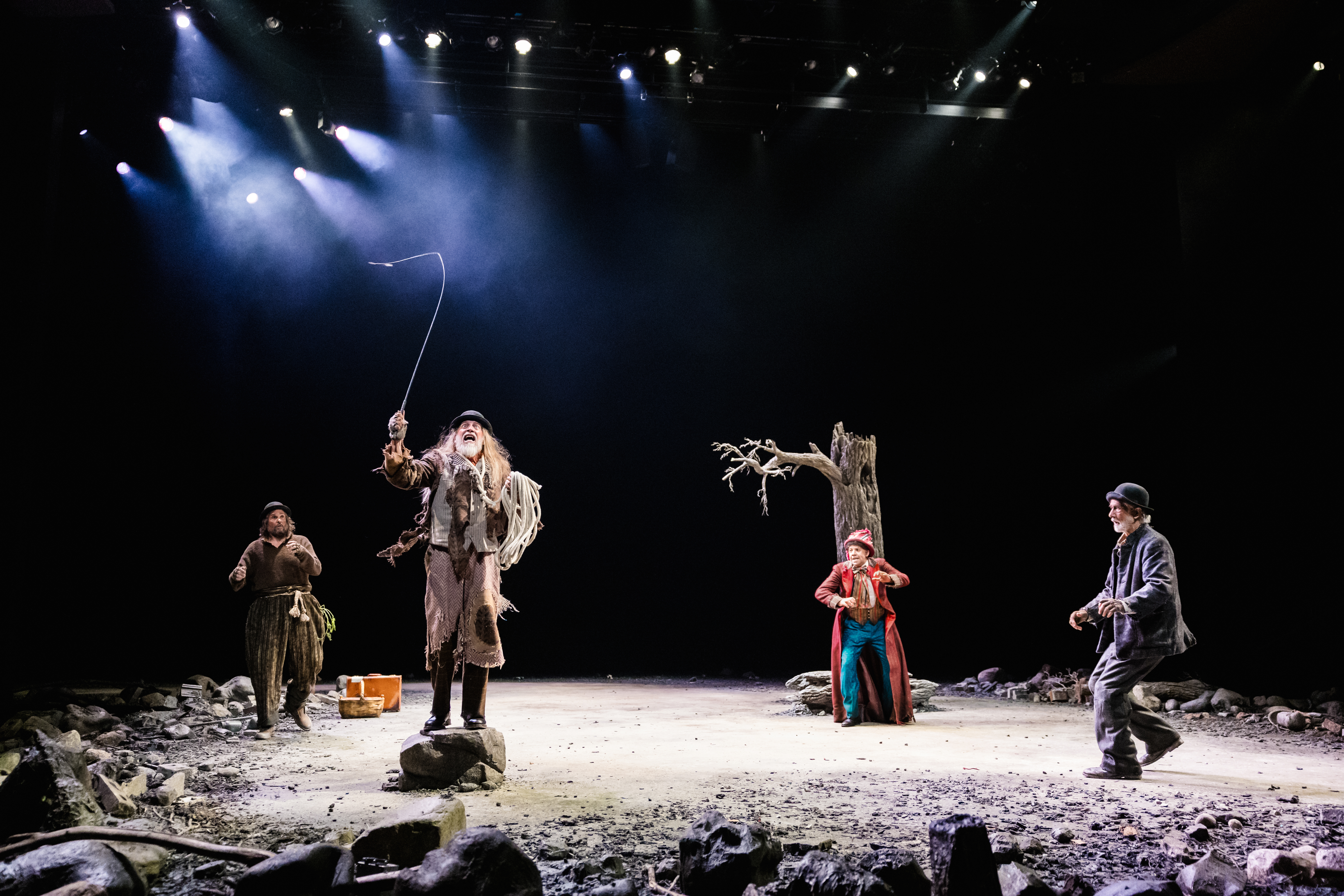
Strathairn (Vladimir)
Great theater challenges the audience by confronting viewers’ biases and prompting them to consider alternative perspectives. Waiting for Godot by Samuel Beckett at the Guthrie Theater, now through October 11, is one such play. When I saw it first during college, I had such a visceral response to its Absurdist form of drama and lack of traditional structure that I nearly left during intermission. Indeed, director and Guthrie Artistic Director Joseph Haj acknowledges this type of response in the play guide’s feature essay: “Waiting for Godot is demanding. It just is. The play asks more from its artists and audience than other plays.” That Haj has chosen this play to open Guthrie’s 2026-27 season, after a fifty-year gap, is a testament to his willingness to challenge audiences with classic and new works that “illuminate what it means to be human.”
What I discovered during this second viewing many decades later is the underlying humanity, passion, sweetness and profoundness of the characters and themes. This is aided by the absolutely brilliant acting of David Strathairn (Vladimir), Jimmy Kieffer (Estragon), William Sturdivant (Pozzo) and Jim Lichtscheidl (Lucky). Veteran stage and screen actor Strathairn, best known for his portrayal of journalist Edward R. Murrow in the film Good Night, and Good Luck and in his Guthrie debut, plays his Vladimir with a gentle, hopeful sweetness during his interactions as loyal friend to Estragon and witness to Lucky and Pozzo’s performances. Kieffer gives his Estragon an angry, anxious, yet vulnerable demeanor. Sturdivant and Lichtscheidl give masterful performances as slave and owner. Lichtscheidl’s “thinking” performance drew audience applause.
Set on a dystopian country road beside a leafless tree, the play follows two tramps, Vladimir (“Didi”) and Estragon (“Gogo”), as they wait endlessly for the mysterious Godot, who never appears. Shout out to scenic Designer Marion Williams, who has created an evocative post-apocalyptic stage. To pass the time, the men engage in fragmented, repetitive conversations about their past, religion, and even contemplate suicide. Their monotony is interrupted by Pozzo and his servant Lucky, whose arrival and bizarre interactions add to the sense of absurdity. After Lucky’s chaotic “thinking” performance and Pozzo’s indifferent cruelty, a boy (Antonio Teodoro) arrives to announce that Godot will not come today but may arrive tomorrow, prompting Vladimir and Estragon to consider leaving, but stay.
The second act mirrors the first, with subtle changes such as green leaves appearing on the tree and transformations in Pozzo and Lucky—Pozzo is now blind and Lucky mute. Despite attempts to help each other, all characters remain trapped in cycles of confusion and inaction. The boy returns with the same message about Godot, and Vladimir and Estragon’s final attempt at escape—trying to hang themselves—ends in farce. Ultimately, they decide to leave but do not move, highlighting the play’s themes of repetition, uncertainty, and the futility of searching for meaning or religious salvation that never arrives.
There is no traditional storyline and few dramatic arcs. The characters perform frantically, but their futile waiting and lack of insight or understanding underscore the meaninglessness of their daily existence. As my companion noted, the play serves as a personal Rorschach Test; each viewer is left to interpret and understand it independently of the playwright. In fact, Samuel Beckett did not provide a definitive interpretation of “Waiting for Godot.” Instead, he embraced ambiguity, allowing various interpretations to emerge. Aside from the existentialist themes, what stood out to me were the political themes of the absurd cruelty of oppression, authoritarianism and capitalist greed. Beckett’s experiences during World War II, including his involvement in the French Resistance’s fight against fascism, influenced his writing. I also loved that Vladimir found honor and authenticity in his simple commitment to waiting for Godot.
If you are open and curious about a play that challenges and defies theatrical convention, while at the same time offers brilliant acting and flashes into the humor and resilience of the human spirit, I heartily recommend “Waiting for Godot.”
Waiting for Godot by Samuel Beckett directed by Joseph Haj. Now through October 11, Wurtele Thrust Stage, Guthrie Theater, 818 S 2nd St, Minneapolis. Tickets range from $27 to $91, including handling fees at 612.377.2224 (Box Office) or online at guthrietheater.org. Marion Williams, Scenic Designer Trevor Bowen, Costume Designer Christopher Akerlind, Lighting Designer Darron L. West, Sound Designer Carla Steen, Resident Dramaturg Carl Fink, Movement Director Sara Becker, Vocal Coach Annie Enneking, Fight Director Jennifer Liestman, C.S.A., Resident Casting Director Karl Alphonso, Stage Manager Jason Clusman, Assistant Stage Manager Connor Berkompas, Assistant Director.


